
Vehicle-to-Load (V2L) Technology
What Is Vehicle-to-Load (V2L) Technology?
Electric vehicles (EVs) are no longer just a means of transportation. They are quickly becoming mobile energy hubs. One of the most exciting innovations fueling this shift is Vehicle-to-Load (V2L), a technology that allows an EV to power external devices and equipment using its battery.
Your EV Isn’t Just a Car
It’s a Battery on Wheels
EV owners are sitting on one of the most powerful pieces of home energy equipment available today. Most EV owners think of their car as transportation that happens to plug in. But paired with solar, that same vehicle can become a rolling battery bank — one that can charge for free off your roof, powers your home during an outage, and could lower your electricity bill in the process.
Here’s how it works, what it can save you, and why more homeowners are pairing solar with EV charging and storage
THE BASIC IDEA: SOLAR CHARGES YOUR CAR FOR FREE
When you install solar panels, you’re generating your own electricity during daylight hours. Instead of sending that extra power back to the grid for a small credit, you can use it to charge your EV directly when you’re at home. That means:
- You’re not paying utility rates to fuel your errands
- Charging during the day when your panels are producing the most power
- A car that essentially functions as another backup energy source
PROJECTED SAVINGS
Hundreds of dollars a year in gas or grid-electricity savings — money that used to go to a utility company, or a gas station, now stays in your pocket.
THE NEXT STEP: YOUR CAR AS A BATTERY
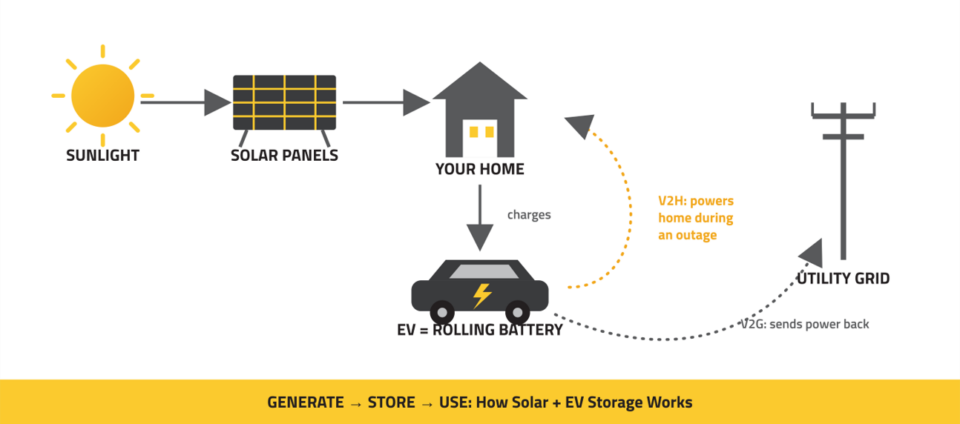
This is where it gets interesting. Many newer EVs support bidirectional charging which is a technology that lets energy flow both ways between the car and your home. This comes in two main forms:
- Vehicle-to-Home (V2H): Your EV can power your house directly, like a backup battery (similar to a Tesla Powerwall or FranklinWH storage system).
- Vehicle-to-Grid (V2G): Your EV can send power back to the utility grid, sometimes earning you credits or payments for helping stabilize the grid during peak demand. Currently, this feature is only being tested with electric public school buses in a pilot program.
In practice, this means your EV’s battery can:
- Power your home during a grid outage
- Cover your evening energy use with the power your panels captured earlier in the day
- Act as a resilience hub in the case of an extended power outage a mobile battery can be taken to local fast charging station, be charged in half hour and come back to fuel the house again and again. Charging stations have a high chance of having power during outages because their infrastructure is buried in the ground and usually not affected.
WHY PAIRING SOLAR + EV STORAGE MAKES FINANCIAL SENSE
When you combine solar generation with EV-based storage, you’re essentially building a system that:
- Generates your own electricity during the day
- Stores the surplus in your car’s battery instead of losing it to the grid at low buyback rates
- Uses that stored power in the evening or during an outage, when grid electricity is most expensive or unavailable
This “generate-store-use” cycle is where the real savings show up. Homeowners avoid peak-rate utility charges, reduce dependency on the grid, and get more value out of every solar panel installed — because the energy isn’t just being sold back cheaply, it’s being put to work.
REAL PROJECTS, REAL RESULTS
At Better Tomorrow Solar, we’ve completed several solar-plus-storage projects where the EV itself served as the storage system. These projects have shown homeowners exactly what’s possible:
- Lower monthly utility bills
- Backup power during outages using the vehicle already parked in the driveway
- A faster return on investment for the solar system, since one investment (the car) does double duty as transportation and storage
We’ve seen firsthand how much value this setup adds when it’s designed correctly — and how much confusion exists around what’s possible with today’s EV and solar technology.
IS THIS RIGHT FOR YOU?
If you already own an EV, or you’re considering one and you’re thinking about going solar, this is worth a quick conversation. Every situation is different depending on:
- Your EV model (not all support bidirectional charging yet)
- Energy usage patterns in your home
- Whether you want backup power, bill savings, or both
LET’S TALK ABOUT YOUR PROJECT
We’d love to talk with you about your specific project. Reach out to Better Tomorrow Solar to see how a solar-plus-EV-storage system could work for your home and what kind of savings you could expect.